THE EPIGENOME
DIET, EXERCISE, DISEASE EXPOSURE, TOXIC CHEMICALS, DRUG ABUSE, FINANCIAL STATUS, DIURNAL AND SEASONAL CORRELATIONS, PSYCHOLOGICAL SATE, THERAPEUTIC DRUGS, ALTERNATIVE MEDICINE, SOCIAL INTERACTIONS, AND OUR MICROBIOME CAN AND DO MODULATE OUR EPIGENOME. OUR EPIGENOME REFLECTS HOW WE LIVE DAY TO DAY AND WE COULD EXPECT BY WAY OF LONGEVITY AND QUALITY OF LIFE.
Chroma of Cambridge, MA, Vertex of Brisbane, MA and Twenty Eight Seven of Water Town, MA are major start ups involved in epigenome editing for desired gene expression as to the level and duration. They are busy altering histone and chromatin modifications at specific genome locations. They are busy telling our genes the when, how, and where to do their job ( Nature Works, 13: 127-137, 2015 and trends Genet 32(2): 101-113, 2016). It is all about transcription and gene expression.
Undoing the wrongs done to our epigenome to-date on molecular basis in our life-time is the best way to increase longevity.

I should like to tell my readers to consult India’s great Smriti Srimad Bhagawad Gita on managing the epigenome by yogic practices beyond my summary below.
Modern molecular biology, it appears, is confirming epigenomic verdicts of SBG in that what, when, and how we and our mothers ate and in how we choose to live by pranayama and vyayam (4.29, 6.16. 9.25, and 17.8) can change expressions of genes in our life time and even those of our off-springs.

Epigenome is chemical markers that modify and order the genome to express what genes in the genome, where, and when and not the genome perse. It seems to determine longevity. The epigenome dictates our cell’s operation including its senescence. That it can be passed on from cell to cell and generation to generation then makes our age a matter of inheritance.
mRNA transcript is made from antisense strand of DNA by RNA polymerase and mRNA, with the help of the ribosome, rRNA, and TRNA make proteins that run our life.
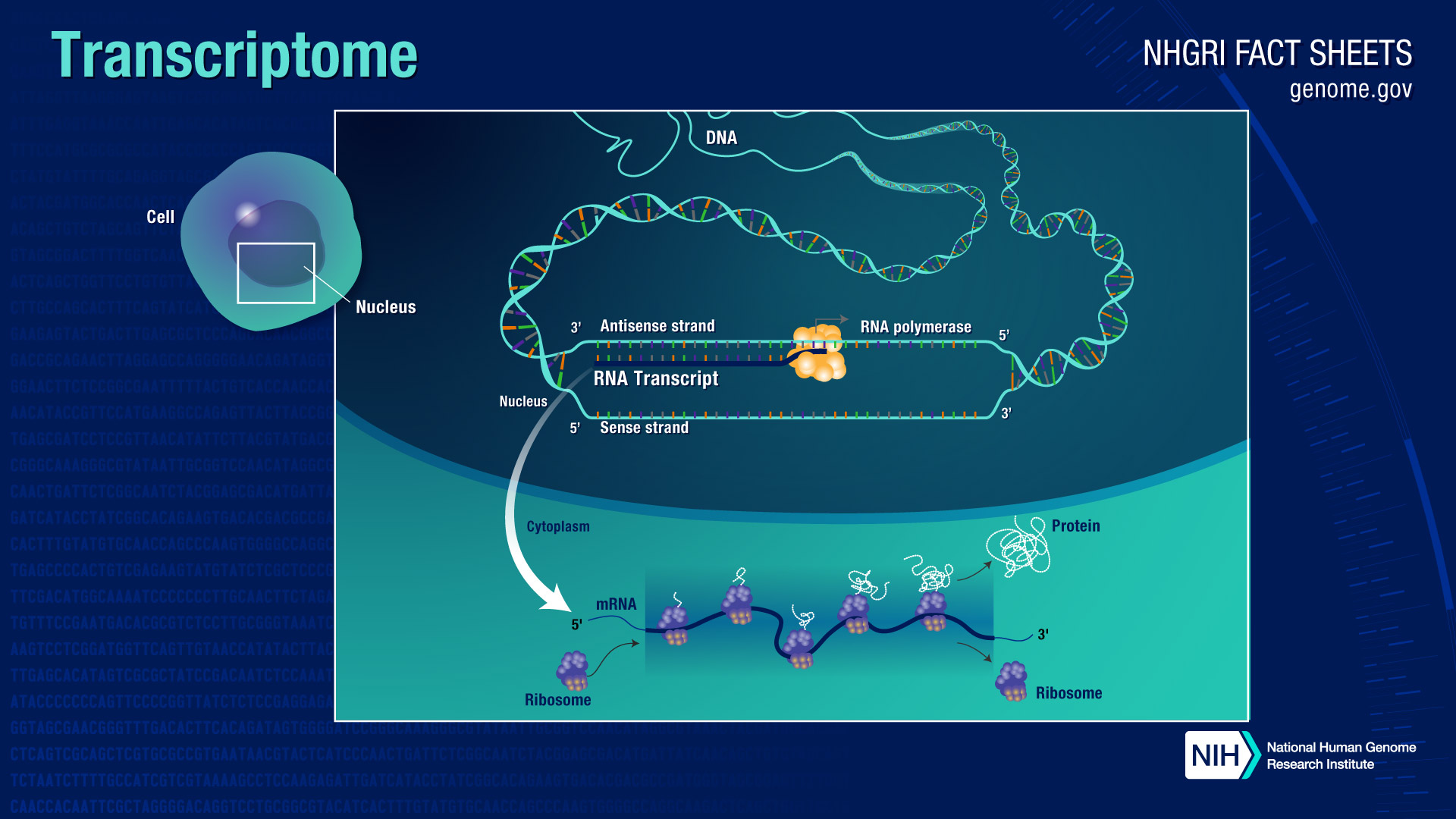
NATIONAL GENOME RESEARCH INSTITUTE
Each chromosome in our cells a single molecule of DNA wrapped around by an octomer of histones contains genes that inaccessible; they become acceble when turned on by unwrapping.


https://en.wikipedia.org/wiki/CDNA_library
Analysis of a collection of mRNAs reveals when and where each gene is turnes on or off in the cells of tissue and the number of transcripts tells us gene activity or expression. Although all cells have same genes, different cell types have a given pattern of gene expression and we can find which gene is active in what cell type. We can convert mRNA without introns into cDNA by enzyme reverse transcriptase and create a library of cloned DNA (genes) of known sequence.
The epigenome by way of cytosine methylation may be quantitative predictor of aging. Dr. Sinclair of Harvard proposes yet a new theory of aging which deals with the cells epigenome. He claims that it is the organization and regulation of histone based chromatin complex and unspooling and spooling, when gone wrong, brings about aging. Epigenetics as the operating system of the cell can drive aging and it can restore it, We have to learn to control and manipulate molecules that cause aging and age related diseases, they say. It is bundling and unspooling of DNA in the chromatin complex (the toggle switch) that we need to learn more about and not the DNA mutations. Wrong spooling seems to be a bigger cause of aging.
Dr. Einstein remarked almost a century ago that a reading of Bhagavat Geeta makes all else superfluous. I should like demonstrate how to translate epigenetic modulation in regard to aging in terms of terse expressions in it. Let us look at them verse by verse.
Work an act well without greed and expectations (chapter 2), Get to know your self (chapter 3), go after transcendental knowledge without lust (chapter 4), doing and acting well is the best way to live (chapter 5), control your mind and senses by yoga (chapter 6), learn of the dimensions of the Divine energy (chapter 7), perfect what you elect to do (chapter 8), cultivate faith and trust with wisdom (chapter 9), secure yoga of understanding (chapter 10), epigenetics is visible when you have met your makr (chapter 11), commit to intense meditation and be with your unmanifest God (chapter 12), know that your soul is separate from the body and the nature you are part of (chapter 13), always follow what is good in nature (chapter 14), we are here to age and die (chapter 15), be fearless, soft spoken, and uncritical of others (chapter 16), improve yourself by helping others by charity and create a better world (chapter 17), and reject actions of smoking, drinking alcohol, eating meat, and harsh words to others (chapter 18). RISE UP ABOVE THE THREE ATTRIBUTES OF NATURE DESCRIBED AS SATVIK, RAJASIK, AND TAMSIK. Be sativik with respect to diet, drug abuse, and interpersonal relationships if you want to live long.
ESXPRESSING GENES AT WILL
Epigenetics is the story of cellular behavior and operation tissue by tissue in our body under the influence of dietary nutrients, environment and toxins we expose ourselves to, and our life-style as to exercise and mobility. Every typt of cell in human body knows when and how much of a gene to express. In other words timing and level of the genotype information in our DNA (in a gene segment) into a phenotype by way of protein products is a matter of cell;s autonomy. We don’t fully understand the regulation of this process but we do know that the daily diet and life style do influence it. Controlling the time and level of diet and lifestyle thus is controlling gene expression at will. You and I can talk to our cells by what we eat, what we breath, what conditions we subject our body to, and the rigor attendant to these events.
Modern molecular biology, it appears, is confirming epigenomic verdicts of SBG in that what, when, and how we and our mothers ate and in how we choose to live by pranayama and vyayam (4.29, 6.16. 9.25, and 17.8) can change expressions of genes in our life time and even those of our off-springs. Triveni P. Shukla, Dec 1, 2022

There are two processes that we need modify in order to materially influence of our epigenome, methylation of the gene segment of our DNA and methylate or acetylate (less lighten the histone wrap) the protein that houses the gene segment of the DNA. Considering 22 pairs of chromosomes and 20,000 genes, the process is quite involved over our life time.
ADDRESS OF A GENE ON THE CHROMOSOME
Gene CFTR: 7 q 3.1.2 means chromosome 7, long arm q, region 3, band no, and subband number. HGNC guideline for naming genes is described in https://www.ncbi.nlm.nih.gov/pmc/articles/PMC7494048/
NAMES OF WELL RESEARCHED GENES
HUGO Gene Nomenclature Committee (HGNC) is responsible for naming genes. The The TOP10 includes TP53, TNF, EGFR, VEGFA, APOE, IL6, TGFB1, MTHFR, ESR1, AKT1.
TP53 (Tumor Protein P53) encodes a tumor suppressor protein with transcriptional activation, DNA binding and oligomerization domains. Others are TNF (Tumor Necrosis Factor), EGFR (Epidermal Growth factor receptor), and VEGFA (Vascular Endothelial Growth Factor).
CHROMOSOMES AND GENES
Chromosome 1, 248787,328 bps, 1961 genes; the largest chromosome
Chromosome 2, 242, 696, 752 bps, 1194 genes
Chromosome 3, 201,105,948 bps, 1024 genes
Chromosome 4, 193,574,945 bps, 227 genes
Chromosome 5, 182, 045, 439 bps, 839 genes
Chromosome 6, 172, 126, 628 bps, 996 genes
Chromosome 7, 160, 567, 428 bps, 862 genes
Chromosome 8, 146, 269, 331 bps, 646 genes
Chromosome 9, 150, 617, 247 bps, 739 genes
Chromosome 10, 134, 758, 134 bps, 706 genes
Chromosome 11, 135, 127, 769 bps, 1224 genes
hromosome 12, 133, 224, 548 bps, 988 genes
Chromosome 13, 113, 566, 686 bps, 308 genes
Chromosome 14, 101, 161, 492 bps, 583 genes
Chromosome 15, 99, 753, 195 bps, 561 genes
Chromosome 16, 96, 330, 374 bps, 795 genes
Chromosome 17, 84, 276, 847 bps, 1124 genes
Chromosome 18, 80, 542, 538 bps, 261 genes
Chromosome 19, 61, 707, 364 bps, 1357 genes
Chromosome 20, 66, 210, 256 bps, 516 genes
Chromosome 21, 45, 090, 682 bps, 215 genes
Chromosome 22, 51, 324, 926 bps, 417 genes; the smallest chromosome
X Chromosome, 154, 259, 566 bps, 804 genes
Y chromosome, 62,460,029 bps, 63 genes
The fact that genes work together and interact in expressing a phenotype is a very complex process. Metabolites of vitamins A and D, fatty acids, some sterols, and zinc are among the nutrients that influence transcription directly. Components of dietary fiber may influence gene expression indirectly through changes in hormonal signaling, mechanical stimuli, and metabolites produced by the intestinal microflora. Choose wholesome diet for a balance and sufficiency of all vitamins and micronutrients including choline.
Klotho, a membrane bound soluble protein found in kidney and brain cells, enhances longevity via endocrine homeostasis.
Telomerec encode two proteins for signaling that can be used as biomarkers of longevity and freedom from cancer.
ANATOMY OF A GENE
First look at the general structure of a cell with the ncleus containing the chromosomes within. The cell contains the genetic information and a gene is within the chromosome in a house of histone proteins. There is DNA that contains genes and all other transcription and translational enzymes such that that the life of a multicellular organism may replicate and self-regulate itself.
 First look at the generalized structure
Genes are made of nucleic acids, linear molecules consisting of a string of four nucleotides, which, in deoxyribonucleic acid (DNA), are adenine (A), thymine (T), guanine (G) and cytosine (C). The expression of genes requires two steps of transcription into mRNA and then translation of the transcript into a functional protein. mRNA is spliced (introns removed) and then translated. There is posttranslational modification, covalent processing events that change the properties of a protein by proteolytic cleavage and adding a modifying group, such as acetyl, phosphoryl, glycosyl and methyl, to one or more amino acids

Please pay attention to the exquisite details below.

https://www.sciencedirect.com/science/article/pii/B9780128125373000044
A complete linear set of nucleotide sequences in a gene, beginning from the 5′ end, has promoter region, untranslated region, exonic microRNA, successive exons and introns, termination codon, and 3′ end untranslated region as microRNA. A gene is thus a self-contained unit of information for molecular unit operations.
We are not able to sequence along the complete length of a chromosome so we paste short stretches of sequenced DNA for the entire chromosome. If a genome assembly is finished to the level of whole linear chromosomes, the ends will contain tandem (consecutive) repeat sequences found within telomeres, ranging from 5-mer to 27-mer repeated several thousand times, which both protect the end of the chromosome from deterioration, chromosomal fusion, or recombination, and as a mechanism for senescence and triggering apoptosis or the death of the cell.

https://www.science.org/doi/10.1126/science.abj6987
The summary above of the complete T2T-CHM13 human genome assembly describes. (A) Ideogram of T2T-CHM13v1.1 assembly features. For each chromosome (chr), the following information is provided from bottom to top: gaps and issues in GRCh38 fixed by CHM13 overlaid with the density of genes exclusive to CHM13 in red; segmental duplications (SDs) (42) and centromeric satellites (CenSat) (30); and CHM13 ancestry predictions (EUR, European; SAS, South Asian; EAS, East Asian; AMR, ad-mixed American). Bottom scale is measured in Mbp. (B and C) Additional (nonsyntenic) bases in the CHM13 assembly relative to GRCh38 per chromosome, with the acrocentrics highlighted in black (B) and by sequence type (C). (Note that the CenSat and SD annotations overlap.) RepMask, RepeatMasker. (D) Total nongap bases in UCSC reference genome releases dating back to September 2000 (hg4) and ending with T2T-CHM13 in 2021. Mt/Y/Ns, mitochondria, chrY, and gaps.
The genes can me modified as to expression level and timing by methylation of DNA and also the methylation and acetylation of histone protein bundle as described earlier. This is the epigenetic effect for the organism transmissible to the next generation. It doesn’t involve change in the nucleotide sequence of the DNA. What seems to be important is epitranscriptomics that can and does influence gene expression by RNA.
Beyond epitranscriptomics, we are finding that a shortened telomere communicates to our nerve cells for a thicker cortex and that meditation and stress-free social relationship can lengthen the telomere ( Leipszig, Max Planck Institute). The seers (rishis) of ancient India seem to have known this by practice with a goal for 100 years long life.
https://www.sciencedaily.com/releases/2019/09/190927103248.htm#:~:text=Telomeres%20on%20human%20chromosomes%20change%20together%20with%20brain%20structure,-Date%3A%20September%2027&text=Summary%3A,reflected%20in%20our%20brain%20structure.&text=Telomeres%20are%20protective%20caps%20at,shorter%20with%20each%20cell%20division.
Leave a Reply